Ireland and the Lost Tribe of E.A.
The Blue Stones of Atlantis
by William Henry
Surfing the Net one night last fall, a few days after publication of my latest Atlantis Rising article, “Secrets of the Cathars” (Num. 36, November/December 2002), my pulse suddenly quickened. My article connected the genocide of the Cathars or Pure Ones of Southern France, the secret teachings of Jesus and the supernatural blue stones of the Sumerian creator god Enki or E.A that open stargates and cause enlightenment.
Evidence flashed before my eyes that, in addition to Iraq and France, E.A. also operated a blue stone-based “stargate mystery school” at the Hill of Tara in Ireland. Conor Newman, an archaeology lecturer at the National University of Ireland at Galway announced that he had located a massive subterranean temple at Tara.
Since 1992, Newman has been working on the Hill of Tara preparing a survey of the area for the state-funded Discovery Program.
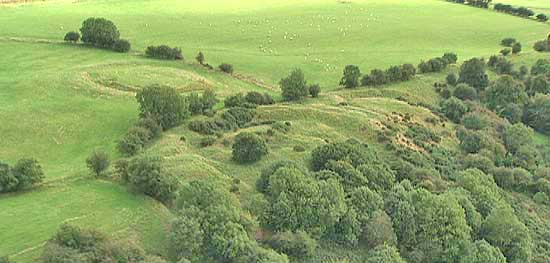
He found the Tara monument using an underground radar device. What they uncovered eventually at the crown of the hill was a huge, oval-shapedmonument measuring about 170 meters at its widest point. Around it are 300 postholes measuring two meters wide. Evidence indicates this ‘Crown’ (tiara) jewel of Irish archaeology was constructed through an enormous effort.
300 towering oak posts once surrounded the hill. Newman thinks it probably dates from 2500 to 2300 BC and still had a big physical presence even after the posts were taken out or rotted. While the site is home to many known archaeological treasures, this latest discovery reveals that the real treasure exists underneath the sacred hill and may soon be revived.
With its revival will come important new information about Enki.
Tara is the prehistoric home of the magical Tuatha Dé Danaan, who are considered to be direct descendents or reincarnations of the biblical Shining Ones (Elohim), the creator gods. W.Y.Evans-Wentz notes that they are described as a race of majestic appearance and marvelous beauty, in form human, yet in nature divine.
They are divided into two classes:
- those which are shining
- those which are opalescent and seem lit up by a light within themselves
The Sumerians called them Anunnaki (literally NUN, ‘fish’, of AKI, ‘light’), which explains why the Irish called them the ‘Lords of Light’ or Illi. They were led by E.A. and brought with them four treasures or power tools:
- the (S)tone of Destiny
- the (S)word of Destiny
- the Cup of Destiny
- the Staff or Spear of Destiny
These treasures were housed in the so-called Cave of Treasures, inside the Mountain of God, where burns a perpetual flame. Tara was considered the Mountain of God, as well as the Illi’s gateway or Ish-Tar Gate to the etheric Otherworld. Passage tombs dot the surrounding countryside. The passage tombs or mounds are called Sidhe (pronounced ‘she’), a pun on the She People or Shining Ones (the She-Ning Ones) who adored Ana, the Great Mother of All Living.
From the earliest dawn of Irish mythology Keltic rites were performed here.
The mythology of the Danaan indicates they had the ability to control the light of the sun through the power of a magical blue stone of miraculous powers. This stone forms the basis for Irish mythology.
E.A. IN IRELAND E.A.
I learned, presided over the Tara assembly as the sun god Fin, a Druid in strangely flowered garments, and with a double-pointed headdress and bearing in his hand a book. Fin’s two-headed miter of fishy form (a play on ‘fin’), his upright rod, spotted or checkered garment and basket in hand, are symbols that are easily recognizable in the Sumerian depiction of E.A. presented here.
His column (i, eye) or pillar of Tara (‘enlightenment’) is remembered as the Tree of the Wisdom of Life of numerous traditions.
E.A. is typified as both the pupil in the eye, with wings and a tail, and as the wisdom-bearing serpent who dwelled within the Tree.
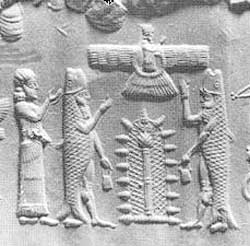
Priests of E.A., wearing fish suits tend his ipillar.
E.A. led the Anunnaki in search of the “blue stones that cause ill,” meaning illumination, luminescence, enlightenment. He found them at a place called Arili (Ireland?).
Sumerian myth romanticized by Zecharia Sitchin says Enki was a genetic scientist who came from the mysterious, and presently controversial, Planet X. The blue stones symbolize the exotic ‘missing’ or ‘hidden’ (‘black’) matter of the universe known as the Philosopher’s Stone or the Black Stone.
Crystallized into Earth density this black stone shifts its vibration into blue stones (actually tones).
The cluster of three orbs symbolize them, just as they do the Word or Life Force of God. When a human places themselves in resonance with the blue stone’s Life Force it transforms them from a human into a god.
Correspondingly, the Irish root word Ea means fire or the light which lightens all, and raises us out of earth life. To the Irish E.A. also signifies:
- a cause
- matter in course of change
- a compact
- a confederacy
- the learned
- a vocation
- learning
- science
- wise
- a flock
- knowledge
- discipline
- instruction
- honor
- respect
- a country
- an island
- a tribe
E.A. founded civilization in ancient Sumeria (modern Iraq). But first, he apparently settled Ireland. As Laurence Gardner notes, Irish mythology of the Anunnaki predates Sumerian civilization by a thousand years or more. Like E.A.’s Sumeria, Ireland comes into history as a full-fledged kingdom, and its sudden origin has perplexed many an historian. Sumerian culture coincides with, the early Irish. It’s as if one culture is the continuation of the other.
Both Irish and Iraqi mythology revolve around the secret teachings of the blue stones of E.A. In ancient Irish religion and mythology Tara was the sacred home for the Ari (later the Ari-ish or Irish) who ranked below the Illi gods, yet above the people. Ireland (Ari-Land) takes its name from the Aris or Arians. Ireland is considered the Great Motherland of the Aryan race, otherwise known as Atlantis, Thule or Tula.
Aryan or Ari-an is a Sanskrit word meaning ‘noble’. The concept of the Aryan race has been wildly misinterpreted. The root of the misunderstanding is in the Sumerian claim that E.A. and the Pure Lady Ninhursag (Mari) cloned the first model of human as a slave race. Into the blood of a second ‘advanced’ human, the Ari or Illi, they put sacred knowledge.
He then separated this new human from the others, taking them to an island home, Poseidon/Atlantis, of which he was the Pa-Tara (father) and founder, the Potei-don or ‘Lord of Wisdom’.
His half-brother Enlil, who sought to keep humanity at the level of dim-bulb, Earth-bound slaves, opposed him. Tara is, conceivably, one of E.A.’s laboratories of enlightenment and the place where he brought ‘the Children of Atlantis’, the lost tribe of Enki, after their banishment by Enlil. Irish mythology insists the secrets of E.A. and his lost tribe remain hidden beneath the soil of Tara.
The Irish make clear that post-cataclysm Atlantean mythology, including that of the blue stones, originated in Ireland and spread to Sumeria, Egypt and India… and Southern France. Among other uses the blue stones, called Blue Apples in Southern France, were used to open gateways or passages to other realms. Gnostic Christians maintain they were present at the Crucifixion.
Afterwards, they were in the possession of the Cathars who were taught the secrets of the blue stones by Jesus. According to Irish belief, E.A. is the root for Iessa, the Holy Spirit, or Jesus.
The Dark Age Church stuck out its velvet-wrapped iron fist and attempted to disarm the Cathars of this strange secret fruit.
That’s why light burned through my veins as I shuttled between Sumerian, Irish and Cathar histories, pouring over currents of symbols and myths that criss-crossed these cultures.
Enlightenment in Ireland, as in Southern France, carried a terrible price. As it would do with the extermination of the Cath-Ari and their Church of Amor or Love (1208-1244), in 1169 the Church of Rome launched a horrifying campaign of terror that shattered the Irish religion and the Mother Church of Tara (‘love’).
After English shock troops operating on behalf of Rome conquered this land, which natives called the Skilly or Blessed Isles for having survived the cataclysm of Atlantis, English priests rewrote its history, performing a full-scale perimeter mythic wipe-down of Tara that left it a sunken wreck – physically intact, spiritually destroyed.
The Illi were banished to the interior world. The Church of Rome transformed them into devils.
As Bruce Rux notes, their stature was considerably shrunk in size, too. This is evidenced by the term henceforth applied to them, fairy folk. The Tuatha Dé Danaan were described as tall, blond and fair-skinned. By adding a ‘y’ suffix to their name, a demonic or diminutive image was created.
The Church transformed E.A., the Potei-Don (Poseidon in Atlantis) or King of Tara, into Potei, Patti, Patty or Saint Patrick, a Church hero who is probably a fabrication of priests who said that, instead of bringing enlightenment, he came to Tara to confront the ancient religion of the gateway at its most powerful site.
Patrick and his followers prided themselves on burning three hundred volumes of Irish histories and Druidical writings. The destruction of the teaching of E.A. (the King of Tara) has never been completed. The investigations to be made at the Hill of Tara will have far-ranging implications on our understanding of ancient Irish history and the story of E.A.
This understanding will enlighten the origins of Hinduism, Judaism, Christianity and Islam, as well. They will reveal their common roots. Today, civilization threatens the temple at Tara. Mr. Newman is concerned about a planned extension of the N3 motorway from Clonee to just north of Kells.
One of the sections from Dunshaughlin to Navan runs along the east side of the Hill of Tara. Newman has absolutely no doubt that they will be destroying dozens of monuments connected to Tara (and E.A.).
This flickering lantern cannot be allowed to fade.
THE ARK AT TARA
There is a fascinating and powerful connection between theblue stones of E.A., Ireland, and the Ark of the Covenant, the golden vessel through which the bright Divine Light presence of God appeared to the Jews. According to Irish lore, the ‘lost’ Ark of the Covenant is hidden at Tara.
Early in the 20th century a group of Israelites, connecting tara with Torah, came to Tara with the conviction that the Ark of the Covenant was buried at the famous hill. They dug the Mound of the Synods in search of the Ark but found only some Roman coins.
Official excavation in the 1950s revealed the circles of postholes, indicating the construction of substantial buildings here. In several of my books and in the aforementioned AR article, I have deduced that the Anunnaki operated a ‘Tara gate’ at a place called Eschol (translated as ‘stone’). Called the ‘valley of the cluster’ (as in grapes), the Bible locates Eschol in Canaan, the ‘Promised Land’.
The Book of Numbers (13) tells us Joshua stole these blue stones, symbolized by a cluster of enormously heavy grapes, from the Anunnaki at the valley of Eschol and returned them to Moses along with a warning, “the land there eateth the people up”. I have interpreted this cryptic phrase as meaning the Anunnaki were operating a gateway that caused people to vanish. The blue stones symbolized this gateway.
The Bible is mute concerning what Moses did with the blue stones of the Anunnaki. This is strange considering they potentially represent the core secrets of the universe. These blue stones are believed to be sapphire crystals containing cosmic secrets ‘etched by the hand of God’. Talmudic-Mishraic sources say they were transparent, flexible, blue and, like the grapes of Eschol, very heavy.
Graham Hancock mentions these stones in The Sign and the Seal, speculating that Moses knew they were hidden on Mount Sinai and that they are meteorites possessing a supernatural power source. Further, he suggests they are a cipher for the Holy Grail.
The cluster of grapes, or blue stones, symbolize the Grail. Most Ark researchers sidestep the blue stones for lack of readily available information, and for the fact that they were smashed by Moses and replaced by a second set of tablets containing the Ten Commandments. An enormous wealth of understanding emerges when we connect the blue stones of E.A. with the Ark of the Covenant. As I wrote in Ark of the Christos, the connection between E.A. and the Ark is easily made. The blue stones were given to Moses by a God of light on the glowing or smoking mountain of light, Sinai, which is considered a metaphor for the Tree of Wisdom and the gate to God.
Apart from the Sinai/Tree of Life metaphor, a smoking mountain is either a mountain on fire or a volcano. The god most closely associated with the volcano is the god of alchemy Vulcan or Hephaestus, the gold/soul smith whom the Sumerians called E.A.
E.A. appeared before the Sumerians as the Aryan god Ahura had appeared when seen in his glowing ark on top of Mount Hara, the mountain of Is-Tara, as a being of light.
AHURA
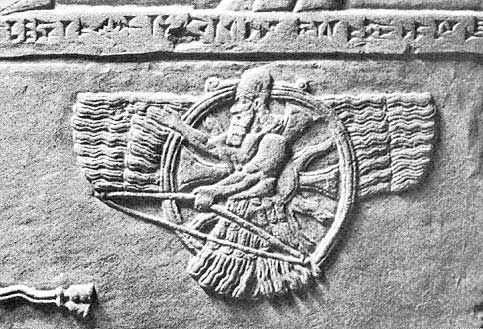
This deduction that E.A. is the God of light of the Ark brings up another. There were two teachings of Moses. The first is the blue stone-based enlightenment teaching of E.A. The second, the Ten Commandments, a penal code for the Israelite slaves, is Enlil’s, whose editors removed the mention of the enlightening blue stones from the biblical story.
For some reason God lost interest in the Ark by Jeremiah’s time (580 BC); telling the Israelites not to think of it, remember it or magnify it any more.
This is probably because the Israelites lost the Ark, probably to Nebuchadnezzar. Jeremiah was instructed by God to hide the secret stones of Israel in the face of the threat from Nebuchadnezzar, the priest-king of Marduk, the ‘Bright’, ‘Shining’ god of Planet X and son of E.A., who had assembled a gateway in Babylon through which the Son of God appeared.
The Irish claim Jeremiah brought the stones to Ireland along with the Princess of Tara, founding a Druid school of wisdom based upon the stones. They say a great prophet will arise in the West who will miraculously cause E.A.’s tree of Tara to bud and blossom. Meanwhile, Saddam Hussein believes he is the reincarnated Nebuchadnezzar.
The race to recover the blue stones of Atlantis continues.
Credits: http://www.bibliotecapleyades.net/sumer_anunnaki/esp_sumer_annunaki13.htm
Article written 2002